Goals and expectations
Forever, the way humans are living together is challenged by personal interests, polarization and conflict. Thus, initiatives like Owls for Peace provide a refreshing vision for a constructive dialogue and reasons for shared action. And, indeed, the initiative has seen its place in violent conflicts that go well beyond neighbourhood disputes (see for details see Bontzorlos et al. 2024 and Roulin et al. 2017). Today, the war in Ukraine is ongoing, and so is the violence in the Middle East and just right now in South America. During periods of such destructive conflicts, the strongest impose their rules, leaving little room for dialogue or diplomacy. Equally devastating, human conflict claims lives and obliterates the very environments that sustain them. Through deforestation, pollution, and unsustainable exploitation of resources, ecosystems are pushed to the brink. But perhaps most destructively, war leaves deep environmental scars with forests being erased by explosives, fertile lands are poisoned by chemicals and heavy metals, and entire regions become uninhabitable to plants, animals and humans due to radiation or contamination.
Facing conflict of any kind, we need imaginative initiatives that inspire hope for a sustainable and peaceful future. It is, thus, powerful and timely to connect nature conservation with peacebuilding without doing politics. This intersection is both innovative and essential. In this process, symbols matter, hence, the barn owl representing values of protection, harmony, and coexistence. By rallying around this bird, people are naturally drawn to the broader message of environmental stewardship and peace. Our experience with the Owls for Peace initiative has shown that this approach resonates deeply. People are often surprised by the originality of the concept and quickly moved by its beauty and simplicity. From members of the public to diplomats, and even the Pope himself, who has shown genuine interest and readiness to engage with our work. Thus, initiatives like Owls for Peace offer a glimmer of hope as well as a roadmap for a more peaceful and sustainable future.
To successfully launch Owls for Peace, we need a formal organizational framework with antennas in associated countries. The International Ornithological Union offers a very welcome platform to give credibility, light and attract members. We here describe our goals.
The creation of Owls for Peace
We envisage to establish Owls for Peace in Switzerland, a country renowned for its political neutrality. Switzerland would be a natural and symbolic home for an organization dedicated to fostering diplomatic dialogue and shared action. Some members of our organization are working at the University of Lausanne giving Owls for Peace an academic environment. Science is indeed at the heart of our initiative: we need research to build the foundation of a solid organization, and we need teaching and communication to spread the word. The International Ornithological Union will give the international backup.
Mission and Vision
Owls of Peace is a science-based initiative that promotes sustainable agriculture and cross-border cooperation through the use of barn owls as natural predators for rodent control. By reducing reliance on chemical rodenticides, we aim to protect local ecosystems, support biodiversity, and encourage environmentally responsible farming practices. At the same time, Owls of Peace fosters collaboration among communities and nations by uniting them around shared environmental goals. Through these symbolic and captivating birds, we seek to inspire dialogue, education, and cooperation across diverse cultures and sectors. This initiative is non-political and may serve as an inspiration for other bird systems and even other sectors of the society.
The Owls of Peace initiative is built on five pillars:
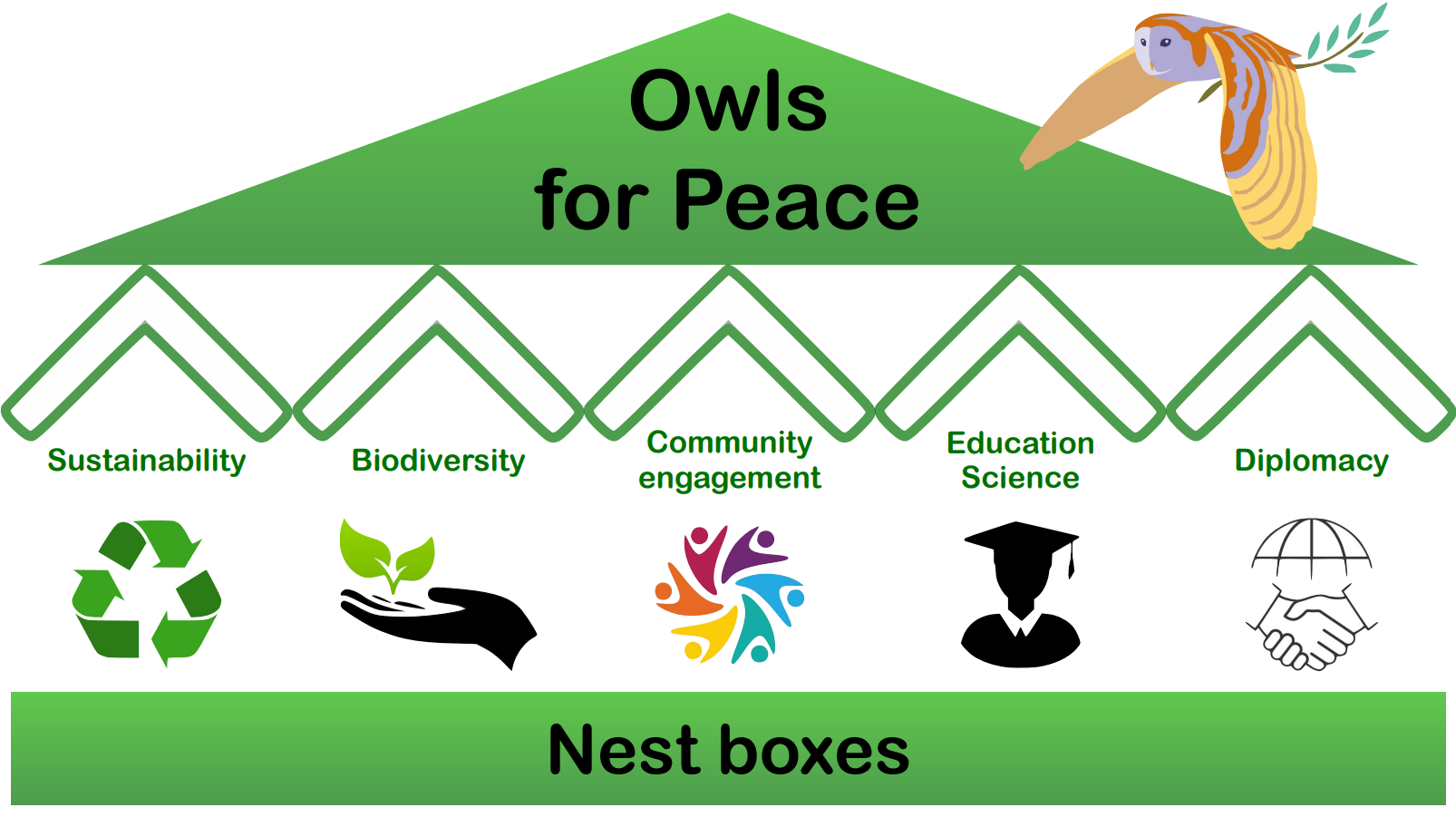
1. Sustainability: By adopting the barn owl as a symbolic ambassador, we promote environmentally friendly farming practices and encourage a more sustainable approach to agriculture.
2. Biodiversity: Collaborating with farmers enables us to raise awareness and drive tangible actions to preserve biodiversity within agricultural landscapes.
3. Community Engagement: The symbolic power of the barn owl inspires the public to protect nature and embrace a shared vision of environmental stewardship and peace.
4. Education and Science: Our collective expertise on the barn owl provides a solid foundation for educational programs aimed at all sections of society, whether thinking of schools, agricultural circles, ornithological and naturalist societies or higher education.
5. Science diplomacy: To foster cross-party collaborations, researchers transform into ambassadors for constructive dialogue and shared action towards common goals. Here, researchers stay non-political and without national agenda.